
Italy
Agip’s part solar PhotoVoltaic (PV) powered petrol station is a particularly attractive green energy proposition since Italy has moderately high solar radiation but also high energy prices where conventional energy source prices and solar energy prices are roughly equal per kW/hour.
Spain
The Repsol car wash outside Madrid airport features flat plate solar thermal panels which preheat the water used for washing cars. Using this relatively low tech, low cost solar thermal energy collecting device, Repsol are able to save the cost of heating the water by conventional means (electric or gas) and therefore also reduce carbon emissions and as a bonus gain a valuable PR advantage. How simple and effective but also quite obvious for a nation famous for its sunny climate.

Gulf Nations
Gulf nations with plentiful fossil fuel resources and resulting low energy prices have to date seen little motivation to install solar energy despite the highest naturally occurring solar irradiance. Abu Dhabi’s Masdar ‘Sustainable City of the future’ may be an encouraging portent of the future and even the wind turbines at the centre Bahrain’s world trade are a further sign of renewable energy at least entering the consciousness. BP Solar calculated that a solar PV array the size and location of the Arabian peninsular could produce all the world’s energy needs.
China
At first glance it may be surprising to discover that China with an only moderate natural abundance of solar radiation is by far the largest user of solar energy with 60% of world use. Of this amount, the relatively mature and low tech solar thermal variety comprises a large proportion with either flat plate, or evacuated tube collectors becoming a familiar site on Chinese rooftops which provides the ‘Low grade’ energy required to heat water. As an energy hungry nation, China clearly sees solar amongst other renewable energy sources as a valuable component of their overall energy portfolio which saves valuable conventional fossil fuels for power stations producing ‘High grade’ electrical energy for industrial and domestic consumption. China’s commitment to invest £34bn (source Joss Garman - Independent) in clean technologies shows they too take the view expressed by US president Barack Obama’s that ‘The nation that leads the clean energy economy will be the nation that leads the global economy’ Could there be a parallel that the companies that lead with introducing green technologies such as Tescos will also lead their sectors?
UK
Sunnier climes such as Spain or Italy have an annual solar energy density of around 200 w/m2 compared to around half that amount in the UK, nevertheless a domestic solar thermal installation in the UK should be able to provide half the yearly requirement for hot water according to Everest, one of hundreds of accredited solar installers in the UK. The fact that such a well know name as Everest, UK’s largest double glazing provider now offers solar thermal shows this technology has reached a certain level of maturity. Unfortunately solar salesman are gaining a bad reputation for miss-selling by overstating the potential gains.Solar Century may be a more trustworthy port of call being one of the longest established suppliers.
Government encouragement of the renewable electricity generating sector includes a range of guaranteed buy back schemes known as ‘Feed in tariffs’. For example renewable energy supplier Segen, is offering a 3.9 kW system (domestic users may use between 4kW/h and 10 Kw/h per day) comprising a rooftop solar PV array of 22 Sharp 180w panels costing £17,000 fully installed (after a £2,500 government grant and including the reduced 5% rate of VAT). The feed in tariff for renewable energy systems up to 4kW is 36.1p per kWh which Segen calculate would give a return of approximately £1,600 per year guaranteed for 25 years. (Note that the average annual amount of energy produced by a solar PV panel is typically only 10-25% of the ‘Rated’ output of the solar panels which is calculated according to their performance under a standard test irradiance of 1000W/m2 which corresponds to the maximum irradiance expected on a clear day in summer at moderate latitudes).
Germany with a similar sunshine level to the UK has long since been offering feed in tariffs giving it the world’s biggest installed capacity of solar PV with 5.5 GW compared to the UK’s 0.021 GW and a total worldwide total capacity of 14.8GW capacity. The money for these government subsidies is not as free as the energy source itself and has resulted in Spain drastically cutting back their commitment to renewable after perhaps too heavy an initial surge. Greece who are old hands with solar thermal have long since announced the intention of similar government PV/ wind incentives but will no doubt have to review such ideas in the wake of enforced austerity measures. Solar it seems will have to thrive more on its own merit alone helped not so much by governments but rising conventional energy rates.
The future
According to Dr. NJ Ekins-Daulkes physics lecturer at the Grantham Institute for climate change, Imperial college, solar PV technology is likely to continue to improve.
Most of the installed solar PV to date is first generation technology which offers 20% efficiency at a cost of $3.5/W. Costs have come down to around half of what they were 15 years ago but have struggled to reduce at the same rate due to a shortage of microelectronics industry grade silicon and the complexity in making silicon wafers themselves.
Leading second generation ‘Thin film’ technology manufacturers such as First Solar can offer 10% efficiency but at a very attractive cost of $1/W due to a more efficient production process and the use of Cadmium Telluride. The ability to apply the basic semi conductor material to glass, plastic or metal foil offers the possibility of integrating PV into the fabric of a building as opposed to panels ‘planted’ on top.
Third generation PV promises both double the efficiencies and half the cost once satellite grade technology is mass produced which comprises multi junction solar cells which can capture a broader width of light emitted from the sun. The Australian company Solar Systems has produced a concentrated PV system where a lens or mirrors focus light on a small but highly efficient (40%) multi junction PV cell.
Hybrids
Heat reduces the output of Solar PV which was no doubt the driver behind an erstwhile little known hybrid solar panel manufactured by Solarus in Sweden which comprises PV panels with water cooling which outputs both electricity and hot water. Per square meter costs of Solarus panels are competitive with non hybrid varieties. The advantage of the Solarus hybrid is that it can achieve more total energy collection from a given area. The disadvantage of any hybrid system is the added complication and the fact that if one component of the combined system fails the whole system may fail.
It should not be overlooked that PV panels require a significant amount of energy to manufacturer which should ultimately be factored into the actual environmental friendliness of the technology. So too the use of the finite and toxic resource of Cadmium. Fortunately the cadmium for PV comes from the bi product of other mining processes.
Passive Solar
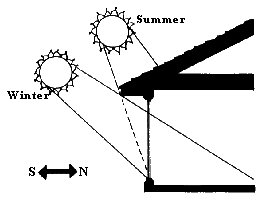
The idea of ‘Bolt-on’ solutions such as solar power and wind power to lower our fossil fuel consumption are attractive to a society that has become dependent upon a ‘Plug and play’ mentality where we can use any energy consuming device anytime day or night. Solar and wind are of course intermittent so the option exists to either store energy via a trans national boarder grid or get used to the idea of managing local consumption in tune with what the elements throw at us.
Solar in Retail
Apart from a few demonstration schemes, retail in general has been slow to see the opportunity of ‘Free’ solar energy that comes with a significant initial investment that depending upon circumstances may not pay back for a number of years. On a positive note major supermarket brands such as Tescos, have made a commitment to solar as part of their plans to decrease their carbon footprint (see Terry Leahy’s environmental credentials) Is it cynism or realism to suggest that the positive PR opportunities associated with environmentally friendly energy sources such as solar are the real drivers of change that tip the economic balance in favour.


 Posts
Posts



